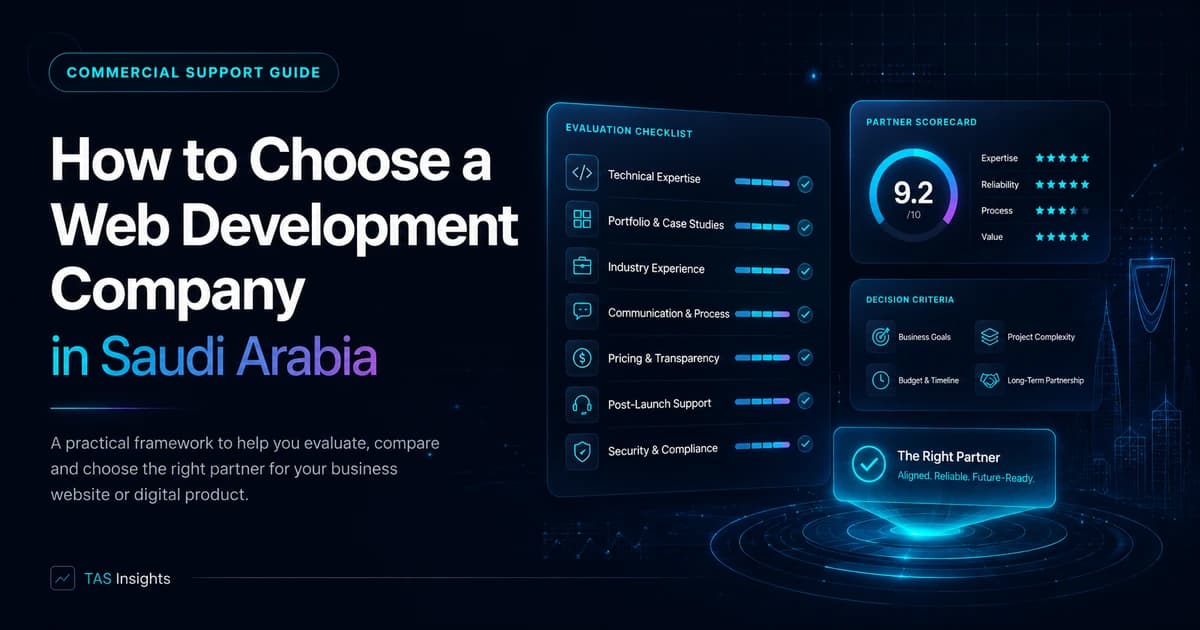
How to Choose a Web Development Company in Saudi Arabia
The best partner is not the company with the longest service list. It is the team that can explain your scope, trade-offs, ownership and launch responsibilities clearly.
Quick Answer
Choose by project fit, evidence and operating clarity
To choose a web development company in Saudi Arabia, compare relevant live work, discovery quality, Arabic and English capability, technology reasoning, SEO implementation, security practices, source-code ownership, quality assurance and post-launch support. Ask every shortlisted team to explain the same business scenario so differences become visible.
Key Takeaways
What matters before the build begins
These points define the decision behind the search query and keep the project grounded in business value.
Relevant live projects are stronger evidence than screenshots or a generic capability deck.
A good company asks operational questions before recommending technology.
The proposal should explain ownership, exclusions, testing and maintenance.
Arabic and English capability should be demonstrated in layouts and content workflows.
SEO should be visible in architecture, templates, rendering and internal links.
The lowest quote is risky when important responsibilities are not defined.
Step One
Define the project before comparing companies
A company cannot provide a useful recommendation if the brief only says “we need a modern website.” Define the main audience, business action, languages, page groups, content readiness, integrations, account features and launch constraints. This gives every candidate the same problem to solve.
Separate must-have launch requirements from optional ideas. This prevents one company from quoting a focused first phase while another includes every future possibility. Comparable scope produces more meaningful differences in approach, cost and timeline.
Minimum briefing information
- Business objective
- Primary users
- Arabic and English requirements
- Core pages and journeys
- CMS and editing needs
- Required integrations
- Reference experiences
- Launch window and approval team
Portfolio Review
Inspect live projects that match the type of work
A beautiful restaurant website does not prove that a team can build a booking platform, marketplace or enterprise portal. Ask for examples that share the same operating pattern: lead generation, content publishing, e-commerce, customer accounts, scheduling or dashboards.
Open the examples on mobile. Test navigation, forms, language switching, loading behaviour and error handling. Ask what the company actually delivered. Some portfolios combine work from multiple partners, so clarify responsibility for strategy, design, development, infrastructure and maintenance.
Real Project Visuals
Platforms and websites built across different business models
Decision Tool
Use a scorecard instead of choosing by presentation
| Area | Evidence to request | Warning sign |
|---|---|---|
| Discovery | Questions about users, workflows and success | Immediate platform recommendation before understanding scope |
| Design | Responsive prototype and reusable design system | Only static homepage mockups |
| Engineering | Architecture, integrations, testing and deployment plan | Unclear ownership or reliance on unexplained plugins |
| SEO | Rendering, metadata, schema, internal links and migration plan | Promise of rankings without implementation detail |
| Arabic | Real RTL examples and bilingual content workflow | Translation added after design |
| Support | Defined warranty, monitoring and response process | No plan after handover |
Due Diligence
Questions that reveal technical and SEO maturity
- 01
Why is this platform suitable?
The answer should connect technology to content, features, team capability, security and maintenance.
- 02
How will important content reach search engines?
Look for server rendering, crawlable links, metadata, canonical handling, sitemap and structured data.
- 03
How are performance and accessibility tested?
Ask for device testing, Core Web Vitals, image optimisation, keyboard checks and form labels.
- 04
How are integrations monitored?
The team should explain validation, logs, retries, permissions and error ownership.
- 05
Who owns every account and asset?
Confirm source code, hosting, domain, analytics, design files, CMS and third-party services.
Planning Check
Need help turning the requirement into the right scope?
Share the website goal, required pages, languages, integrations and timeline. TAS can help you identify whether the project needs a focused business website, a custom platform or a staged roadmap.
Ask TAS on WhatsAppCommercial Protection
Check the proposal, contract and ownership model
The proposal should name deliverables, milestones, approval windows, revision limits, exclusions and payment triggers. It should explain how scope changes are estimated and whether delays in content or approvals affect the timeline.
Confirm source-code ownership, third-party licences, account access, confidentiality, backup responsibility, security updates and termination support. Legal terms should be reviewed by qualified advisers, but the technical team must still provide an accurate inventory of what the business will own and operate.
Risk Signals
Red flags when selecting a web development company
Guaranteed Google rankings
No company controls organic rankings. Ask what technical and content work is included instead.
One technology for every project
A serious recommendation should reflect the business model and operating constraints.
No discovery stage
Skipping workflow and content planning usually moves uncertainty into expensive development.
No live portfolio access
Screenshots do not demonstrate responsive behaviour, forms, speed or real content structure.
Unclear post-launch support
A launch without monitoring, backups and maintenance ownership creates operational risk.
Hidden third-party dependencies
Plugins, themes, APIs and licences should be disclosed before the contract is signed.
Final Validation
Use discovery to test the working relationship
For larger projects, a short structured discovery phase can be safer than awarding the full build from a sales proposal. The output may include user journeys, sitemap, content model, technical risks, integration notes, delivery phases and a refined estimate. This work should create reusable project documentation, not simply extend the sales conversation.
Observe how the team handles uncertainty. Strong partners document decisions, surface conflicting requirements and explain what must be validated. They do not hide every unknown inside a fixed promise. The discovery phase also reveals whether stakeholders can provide content and approvals at the pace required by the proposed timeline.
Ask how the discovery artefacts can be used if the build does not continue. Clear ownership of the output creates accountability and prevents the client from being locked into a company before the architecture is understood. A useful discovery also identifies which assumptions require legal, security, content or commercial approval outside the development team, and records the person responsible for each decision before design or development continues into expensive implementation and rework.
Commercial Transition
When TAS may be a suitable fit
TAS is most relevant when a business needs more than a visual brochure: custom information architecture, bilingual experiences, integrations, SEO foundations, booking or account workflows, dashboards, mobile products or automation around the website.
The first conversation should establish fit. If a simpler managed platform is more appropriate, the recommendation should say so. If custom development is justified, TAS can separate the launch scope from later product phases and explain the technical ownership required.
TAS Project Evidence
What these decisions look like in real digital products
The examples below are presented as TAS project showcases. They demonstrate different website and platform patterns without inventing performance results or claiming that one architecture fits every business.
Consulting Website · Lead Generation
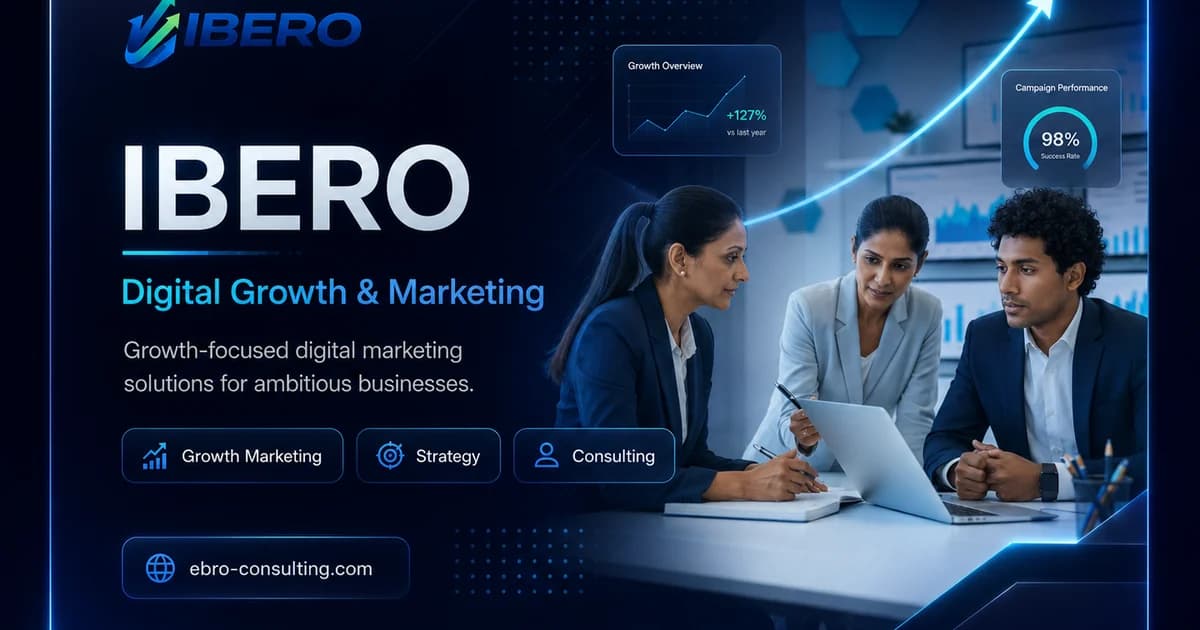
IBERO
A B2B consulting presence structured around services, credibility, strategic positioning and lead-generation actions.
View live projectWebsite · Booking Platform · Mobile Apps
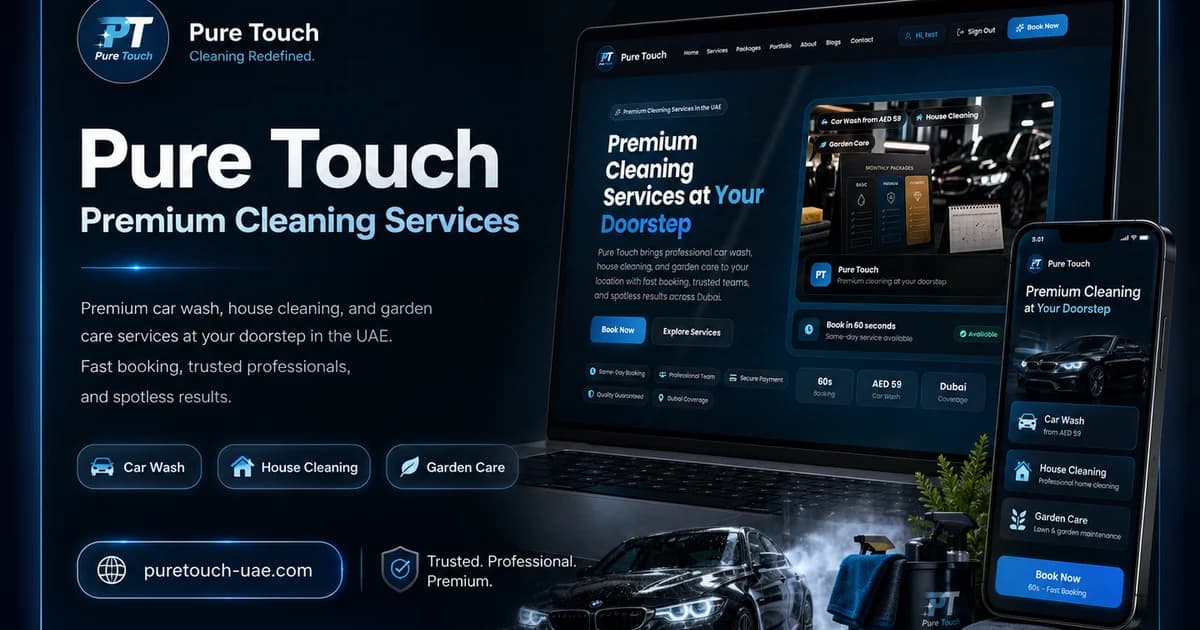
Pure Touch
A service-booking ecosystem with customer journeys across web and mobile, service selection, scheduling and account workflows.
View live projectEducation Platform · Content · User Journeys
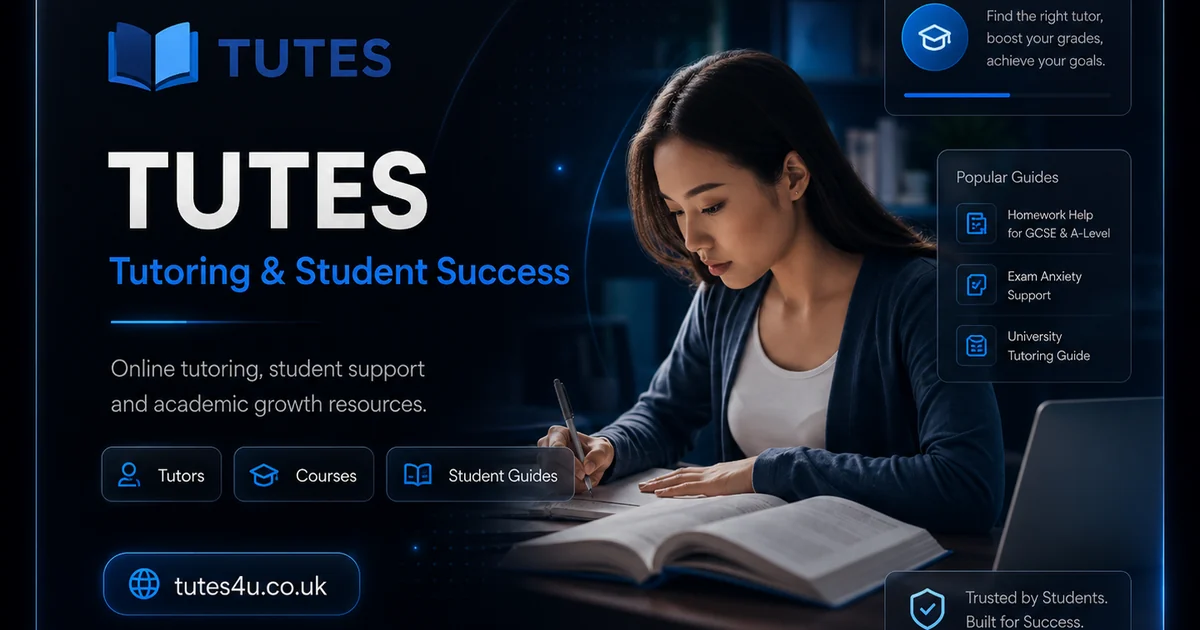
TUTES4U
An education-focused platform that organises tutoring discovery, student guidance and content around distinct user needs.
View live project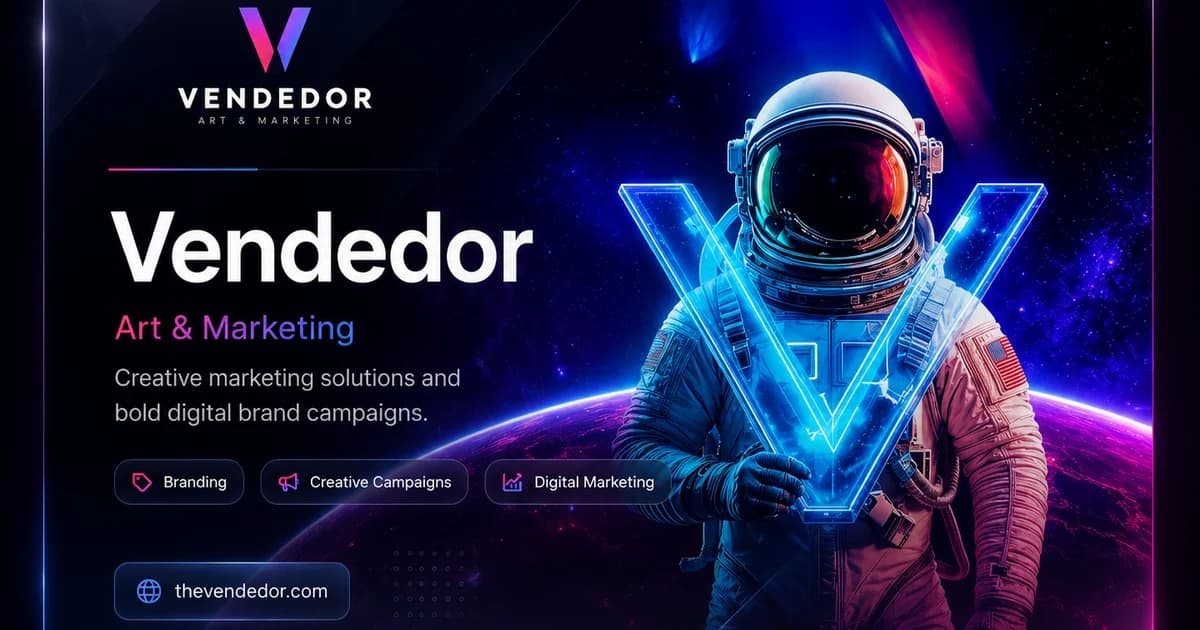
Brand Website · Creative Presentation
Vendedor
A visually led brand experience showing how design direction, message hierarchy and conversion paths can work together.
View live project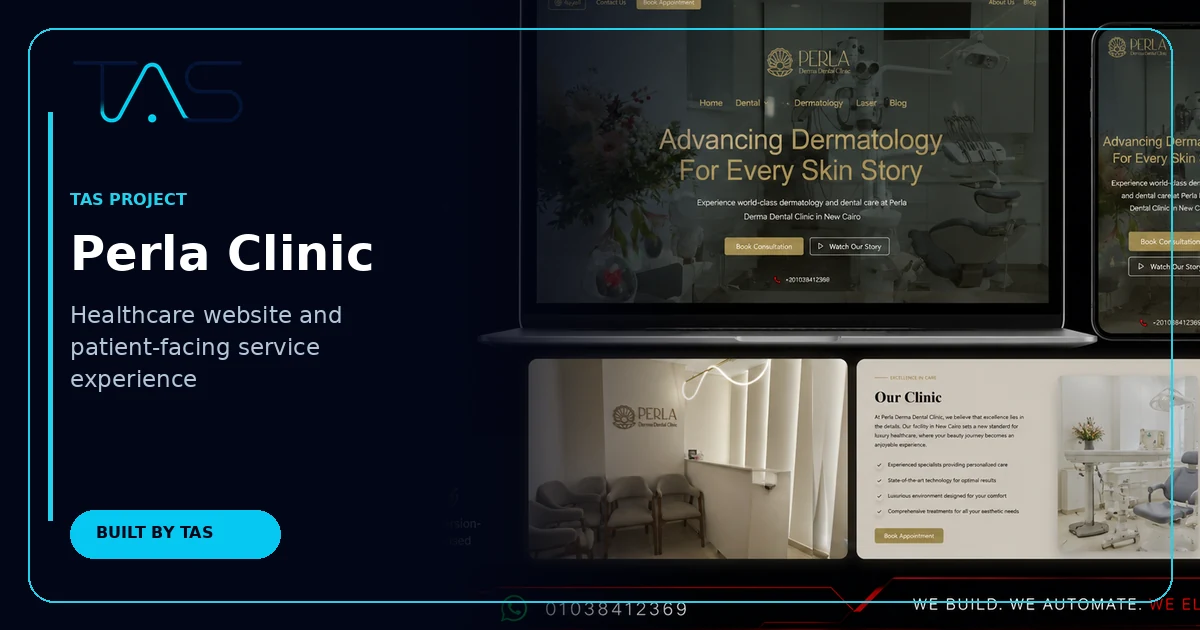
Healthcare Website · Service Discovery
Perla Clinic
A healthcare-focused web experience presenting specialist services, treatment information and clear patient enquiry paths.
Discuss a similar TAS project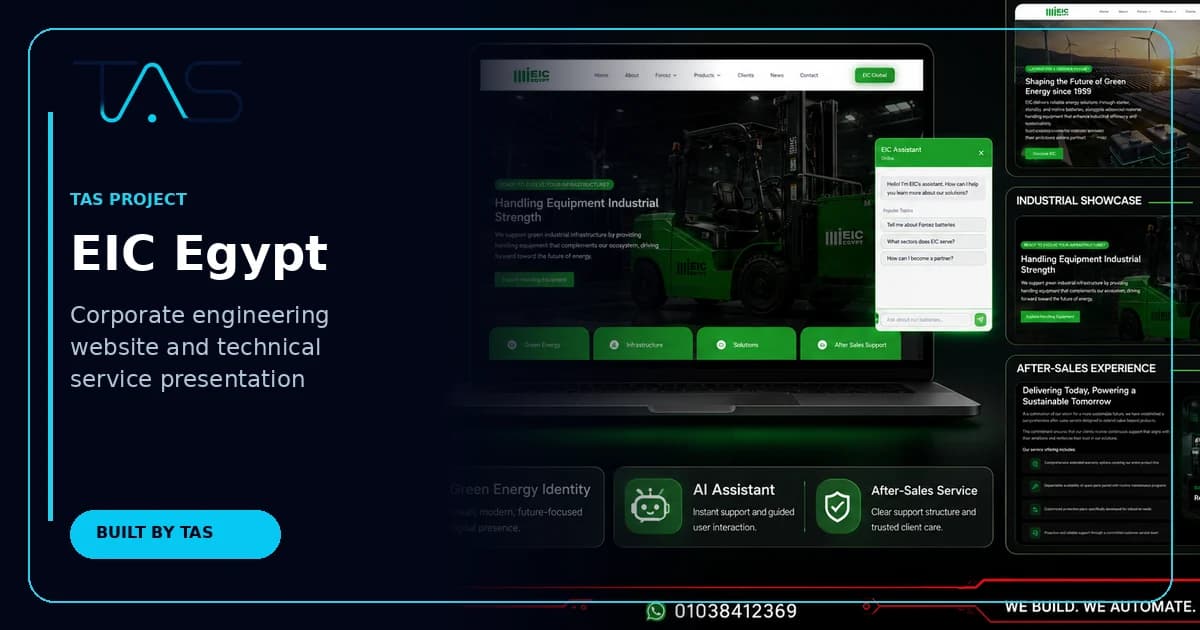
Corporate Website · Technical Services
EIC Egypt
A corporate engineering website structured around technical capabilities, sectors, credibility and business enquiry pathways.
Discuss a similar TAS projectConnected TAS Guides
Web development connects to automation, CRM and AI
These existing TAS guides cover adjacent decisions without competing with the web development cluster.
Frequently Asked Questions
Choosing a Web Development Company FAQs
How do I choose a web development company in Saudi Arabia?+
Define the project, review relevant live work, compare technology reasoning, test Arabic and English capability, inspect SEO and security practices, confirm ownership and evaluate post-launch support. Give every shortlisted company the same scenario so proposals are genuinely comparable.
What should I ask a website development company?+
Ask why it recommends the platform, how content is managed, how SEO is implemented, how integrations fail safely, what testing is performed, who owns source code and accounts, which costs recur and what support is available after launch.
Should I choose the cheapest website quote?+
Not automatically. A lower quote may exclude discovery, content, Arabic layouts, integrations, SEO, testing, migration or maintenance. Compare deliverables and three-year operating responsibility rather than only the initial total.
How can I verify a web development portfolio?+
Open live projects on mobile and desktop, test forms and navigation, inspect language switching and ask what the company actually delivered. Confirm whether it handled strategy, design, engineering, hosting and support or only one part of the work.
What makes TAS different from a standard website agency?+
TAS combines website delivery with custom software, mobile applications, AI, automation, integrations and digital growth. This is most useful when the website needs to connect with wider customer or operational systems rather than operate as an isolated brochure.
Next Step
Compare the project approach—not only the company profile
Share the same brief you are giving shortlisted companies. TAS can respond with a clear scope, assumptions, exclusions and recommended delivery path.
Authoritative sources and further reading
Technical standards and platform guidance change. Review the current source before making a final architecture, security or compliance decision.
- Google Search Essentials
- Google SEO Starter Guide
- Google crawlable links best practices
- Google canonical URL guidance
- Google image SEO best practices
- Google Article structured data
- web.dev Core Web Vitals guidance
- W3C Web Content Accessibility Guidelines
- OWASP Top 10 web application security risks
- Next.js metadata and Open Graph documentation
- Schema.org structured data vocabulary