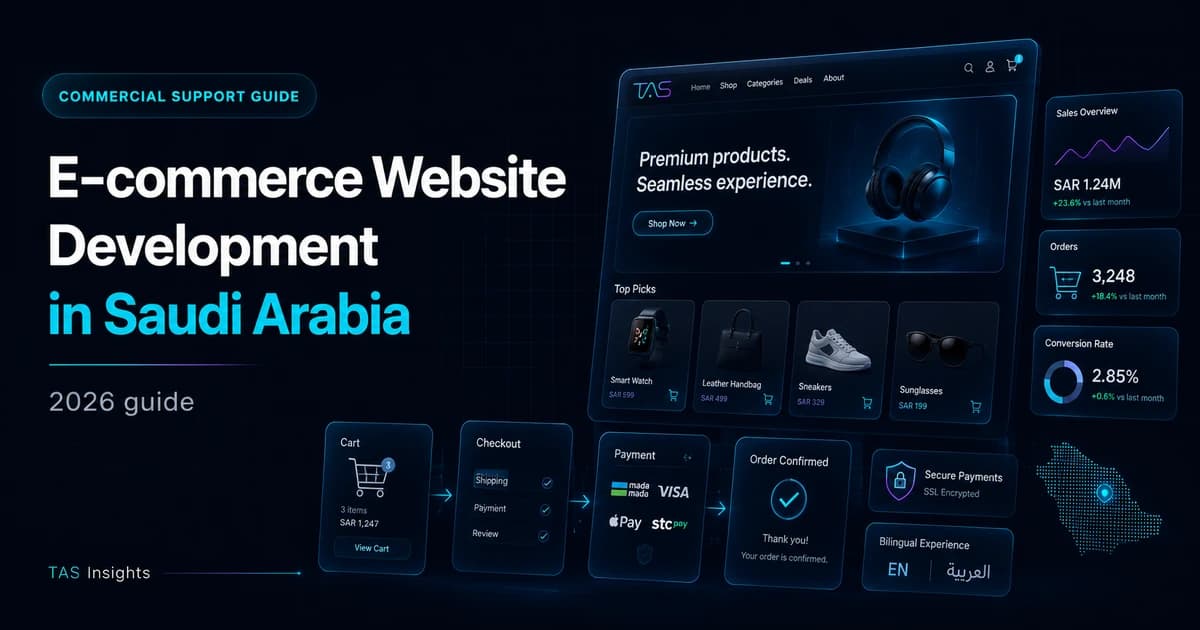
E-commerce Website Development in Saudi Arabia: 2026 Guide
An online store is a connected operating system for catalogue, payments, orders, fulfilment, customer service and growth—not only a product grid.
Quick Answer
Choose the commerce model before choosing the platform
E-commerce website development in Saudi Arabia should begin with catalogue complexity, fulfilment, payments, Arabic and English content, promotions, customer service and integration requirements. A hosted platform can suit a standard retail workflow, while a custom storefront or commerce platform is justified when the business model needs unique journeys or deeper system integration.
Key Takeaways
What matters before the build begins
These points define the decision behind the search query and keep the project grounded in business value.
Platform choice should reflect catalogue, operations and integration needs.
Arabic navigation, search, product data and checkout require proper RTL design and QA.
Payment success is only one part of the order journey; fulfilment and support matter equally.
Product data quality directly affects SEO, advertising and customer trust.
Analytics should connect acquisition, product behaviour, checkout and completed orders.
Legal, tax and privacy requirements should be confirmed with qualified Saudi advisers.
Commerce Foundation
Map the complete e-commerce operating model
The build starts with products, variants, pricing, stock, delivery zones, returns, promotions, taxes, invoices, customer service and fulfilment ownership. If these rules are unclear, the website will expose contradictions at checkout or force teams to manage orders manually.
Create a journey map from discovery to delivery and after-sales support. Include failure states: declined payment, unavailable stock, address problems, cancelled orders, partial fulfilment and refund requests. The platform should support the real operating process rather than assume an ideal transaction every time.
Platform Decision
Hosted platform, open-source store or custom commerce?
| Approach | Best fit | Advantages | Trade-offs |
|---|---|---|---|
| Hosted commerce platform | Standard retail catalogue and fast launch | Managed infrastructure, app ecosystem and simpler operations | Platform fees, extension limits and migration dependency |
| Open-source commerce | Businesses needing more control with established commerce patterns | Flexible ecosystem and broader ownership | Security, upgrades, hosting and plugin governance |
| Headless storefront | Performance-led experiences using a separate commerce backend | Custom UX, flexible content and multiple channels | More engineering and integration responsibility |
| Custom commerce platform | Unique business rules, marketplaces or complex operations | Business-specific workflows and full product flexibility | Higher discovery, QA, security and maintenance requirements |
Real Project Visuals
Platforms and websites built across different business models

Saudi Market Fit
Plan Saudi customer, payment and invoicing requirements
The requirements may include Arabic and English storefronts, local contact and WhatsApp support, preferred payment methods, delivery rules, invoice data, promotions and mobile-first checkout. Confirm the exact payment-provider capabilities and contractual requirements directly with the selected provider.
E-invoicing, tax, consumer protection and personal-data obligations can affect data fields and operational workflows. The development team can implement approved requirements, but the business should obtain current legal and accounting guidance from qualified Saudi professionals.
Saudi e-commerce discovery checklist
- Arabic and English product data
- Payment-provider shortlist
- Delivery areas and fees
- Returns and refund workflow
- Invoice and tax requirements
- Customer-service channels
- Consent and privacy requirements
- ERP, inventory or fulfilment integrations
Customer Experience
Product data and navigation determine whether customers can buy
Useful product pages answer the decision: specifications, variants, availability, delivery expectations, returns, support and trust signals. Filters should reflect how customers compare products rather than mirror internal database fields. Search should handle common spelling, Arabic terms and product identifiers where relevant.
Mobile checkout should minimise unnecessary fields, preserve the cart and provide clear feedback. Accessibility is important for labels, errors, focus states and keyboard behaviour. These details reduce confusion and support both conversion and customer service.
Planning Check
Need help turning the requirement into the right scope?
Share the website goal, required pages, languages, integrations and timeline. TAS can help you identify whether the project needs a focused business website, a custom platform or a staged roadmap.
Ask TAS on WhatsAppSearch and Growth
Build e-commerce SEO around categories and product entities
Search architecture should assign distinct intent to categories, brands, product types and guides. Avoid generating thousands of thin combinations from filters. Use canonical rules deliberately, keep important pages crawlable through links and create useful category content that helps customers compare.
Performance matters heavily on mobile. Optimise product images, prioritise the main visual, reduce unnecessary scripts and monitor Core Web Vitals with real-user data. Structured data must reflect visible product information and current availability.
Operations
Integrations should reduce manual work without hiding failures
Payments
Confirm supported methods, webhooks, reconciliation, refunds and failure handling.
Inventory
Define the source of truth, update frequency, reservations and overselling rules.
Fulfilment
Map labels, tracking, delivery status, exceptions and customer notifications.
CRM and support
Connect customer history and enquiries without exposing unnecessary personal data.
Analytics
Measure acquisition, product views, cart actions, checkout and completed revenue.
Content
Coordinate product information, campaigns, landing pages and editorial buying guides.
Launch Readiness
Test the complete order lifecycle before sending paid traffic
A launch test should cover product discovery, variants, coupons, taxes, delivery, successful and failed payments, confirmation messages, stock updates, fulfilment, cancellation, refunds and customer-service visibility. Test Arabic and English content, mobile keyboards, address entry and the behaviour of external payment pages.
Create test orders that deliberately fail. A resilient system makes the status clear to customers and staff, avoids duplicate orders and records enough information for support teams to investigate. Reconciliation between the website, payment provider and fulfilment system should be part of operational acceptance.
After launch, measure product discovery, search terms, filter use, cart abandonment, payment failures, order value and support reasons. These signals guide merchandising, content and checkout improvements. Review results by device and language because an apparently healthy total can hide a broken Arabic or mobile journey. Do not send substantial advertising traffic until analytics and order operations have been verified in production and support teams know how to respond to exceptions without creating duplicate orders or avoidable customer confusion.
Commerce launch QA
- Successful and failed payments
- Stock and order status
- Arabic and English checkout
- Delivery calculations
- Emails and WhatsApp notifications
- Refund and cancellation flow
- Analytics and revenue events
- Customer-service access to order history
Commercial Transition
How TAS approaches a commerce build
TAS begins with the order and operational journey, then recommends the simplest architecture that supports it. A standard platform may be the right answer when the business follows common retail patterns. A custom storefront or platform becomes relevant when design, performance, marketplace rules or integrations create a real business case.
The scope can be staged into catalogue and checkout, integrations, automation and later optimisation. This reduces launch risk and gives the business measurable behaviour before committing to lower-priority features.
TAS Project Evidence
What these decisions look like in real digital products
The examples below are presented as TAS project showcases. They demonstrate different website and platform patterns without inventing performance results or claiming that one architecture fits every business.
E-commerce · Product Discovery · SEO Content
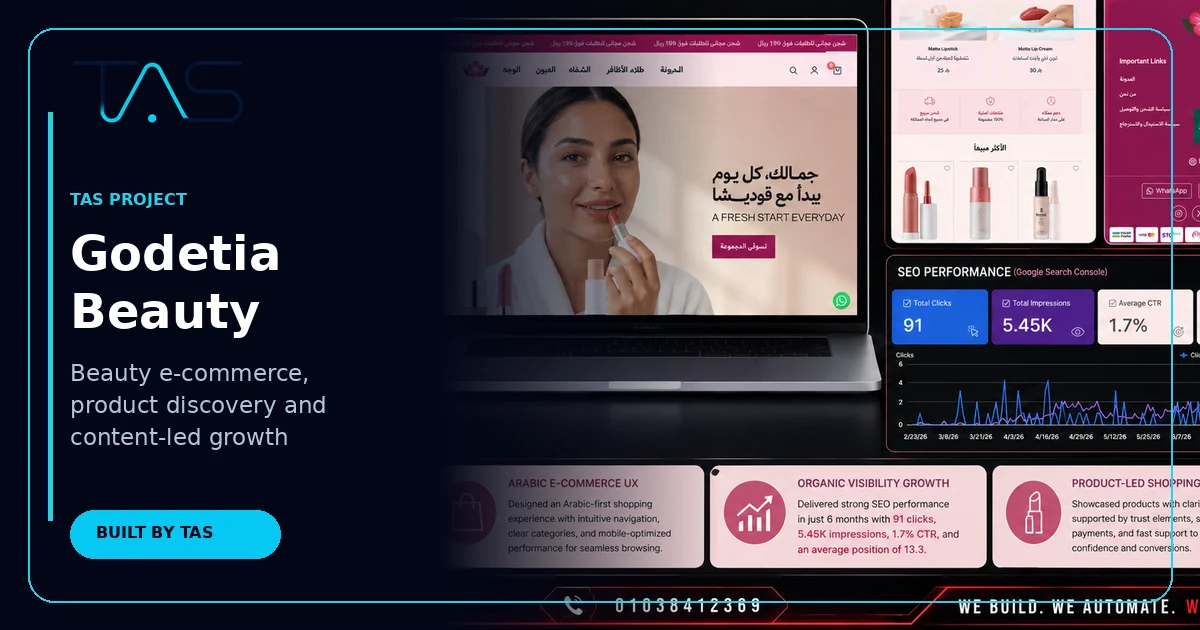
Godetia Beauty
A beauty-commerce presence combining product discovery, category journeys, bilingual content and search-focused editorial pages.
View live projectWebsite · Booking Platform · Mobile Apps
Pure Touch
A service-booking ecosystem with customer journeys across web and mobile, service selection, scheduling and account workflows.
View live projectDigital Product · Subscription · AI Experience
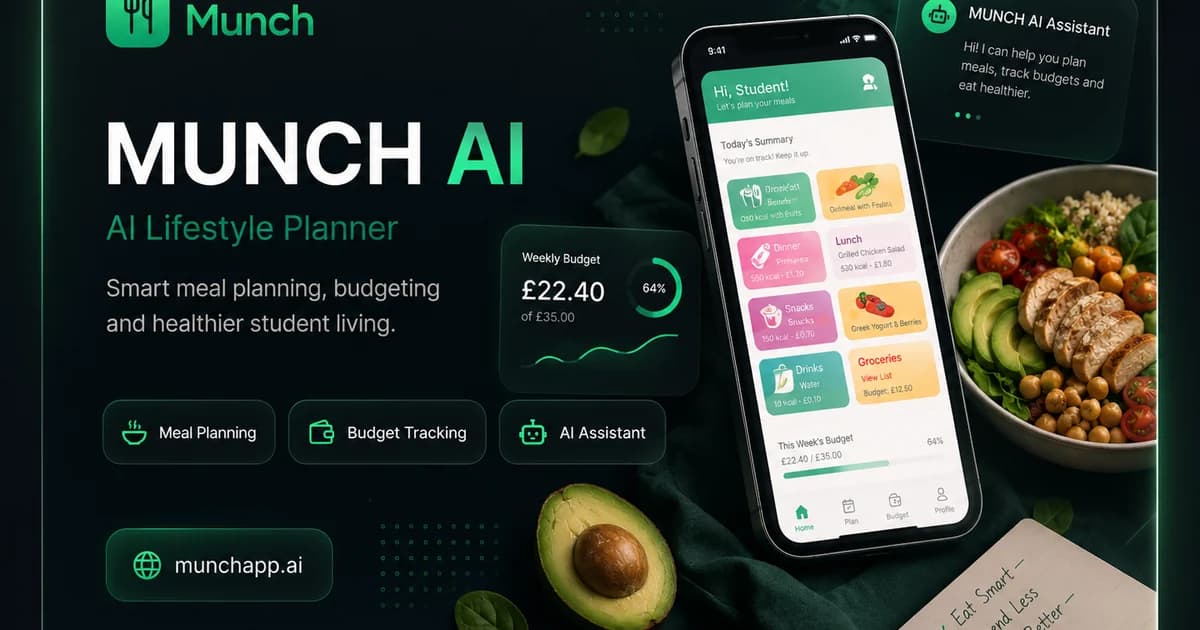
MUNCH AI
A consumer digital product combining public web pages, mobile applications, subscriptions and AI-assisted lifestyle features.
View live project
Brand Website · Creative Presentation
Vendedor
A visually led brand experience showing how design direction, message hierarchy and conversion paths can work together.
View live projectConnected TAS Guides
Web development connects to automation, CRM and AI
These existing TAS guides cover adjacent decisions without competing with the web development cluster.
Frequently Asked Questions
E-commerce Website Development FAQs
What is included in e-commerce website development in Saudi Arabia?+
The scope can include catalogue structure, product pages, Arabic and English content, search, checkout, payment integration, orders, fulfilment, customer accounts, analytics, SEO, security, hosting and support. The exact requirements depend on the operating model and systems already used by the business.
Which e-commerce platform is best for a Saudi business?+
The best platform depends on catalogue complexity, payment and fulfilment requirements, design needs, integrations, internal skills and long-term ownership. A hosted platform suits many standard stores, while custom or headless architecture needs a clear business reason.
Does a Saudi online store need Arabic and English?+
That depends on the audience, but both experiences should be planned together when required. Product data, search, filters, checkout, emails and customer-service content need consistent language ownership and RTL testing.
How should payment integration be planned?+
Confirm supported methods, fees, settlement, refunds, webhooks, test environments and failure handling directly with shortlisted providers. The website should record transaction states accurately and avoid treating a payment redirect as proof of a completed order.
Can TAS build a custom e-commerce platform?+
Yes, when the business model requires custom customer journeys, marketplace logic, integrations or operational workflows. TAS can also recommend a standard platform when custom engineering would not provide enough value to justify the additional ownership.
Next Step
Map the store operations before choosing the platform
Send TAS the product model, languages, payments, delivery process, integrations and launch priorities. We will recommend a practical commerce architecture.
Authoritative sources and further reading
Technical standards and platform guidance change. Review the current source before making a final architecture, security or compliance decision.
- Google Search Essentials
- Google SEO Starter Guide
- Google crawlable links best practices
- Google canonical URL guidance
- Google image SEO best practices
- Google Article structured data
- web.dev Core Web Vitals guidance
- W3C Web Content Accessibility Guidelines
- W3C guidance for text direction and RTL content
- OWASP Top 10 web application security risks
- ZATCA e-invoicing information
- Schema.org structured data vocabulary