Quick answer
There is no single reliable UK app price because the same-looking product can have completely different backend, integration, security and operating requirements. Public UK guides published in 2026 show a very wide market range—from low five figures for focused MVPs to six figures for complex consumer or enterprise products. Use those figures as market context, not as a TAS quote. The useful next step is to define users, journeys, platforms, integrations and post-launch ownership before comparing suppliers.
Key takeaways
What current UK app cost guides actually show
Current UK app-development guides do not agree on one universal figure, which is useful evidence in itself. Rounded Labs publishes bands from roughly £15,000 for simpler projects through £150,000+ for complex builds, while Red Eagle describes simple or single-workflow products from roughly £8,000 and complex or regulated products reaching well into six figures. Other 2026 guides publish different ranges again.
The correct conclusion is not to choose the cheapest published number. It is to recognise that 'mobile app' describes products with radically different delivery responsibilities. A login-based information app, a subscription product, a two-sided marketplace and an operational enterprise tool can all have a similar number of screens while requiring very different engineering effort.
TAS therefore treats market pricing as external context. A project estimate should come from the actual product scope, not from copying a band from an article.
The factors that move a UK mobile app quote
- Platforms: iOS only, Android only, or both at launch.
- Product states: onboarding, accounts, permissions, subscriptions, payments, bookings and edge cases.
- Backend scope: APIs, databases, admin portals, notifications, files and business logic.
- Integrations: CRM, ERP, payment providers, maps, health data, external catalogues or partner APIs.
- Real-time and offline behaviour: chat, live tracking, synchronisation and background tasks.
- Security and governance: roles, sensitive data, audit trails and regulated workflows.
- Product operations: analytics, support tooling, release management and post-launch ownership.
Compare proposals by what is included, not only the headline total
| Area | What a useful proposal should clarify | Why it affects cost |
|---|---|---|
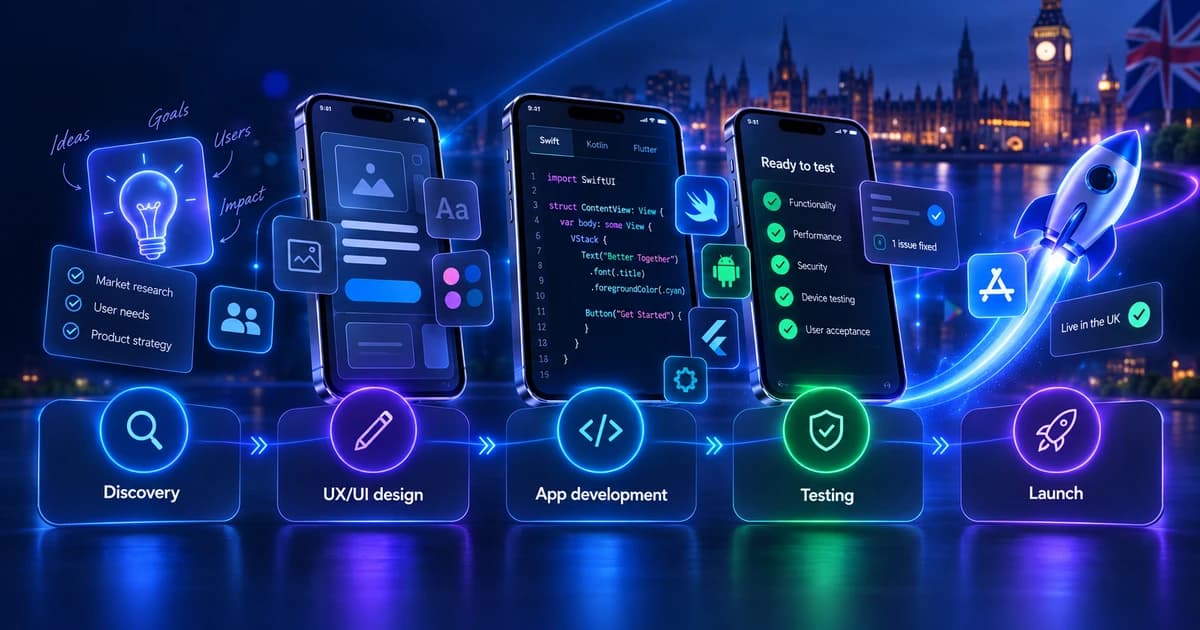
| Discovery | Users, journeys, MVP boundary, risks | Prevents expensive scope ambiguity |
| UX/UI | Screen states, prototype, design system | Defines the real interface work |
| Mobile | Platforms, architecture, device features | Changes engineering and QA effort |
| Backend | APIs, database, admin, auth | Often a large share of total delivery |
| Integrations | Providers, API access, failure handling | External systems add dependency risk |
| Release | Store assets, testing, submission support | Launch work is more than uploading a build |
| Support | Monitoring, fixes, updates, roadmap | Clarifies the cost after version one |
How to reduce app cost without creating a weak MVP
The strongest cost control is usually not choosing a cheaper framework. It is reducing the number of workflows that must be production-ready in the first release. Define the primary user, the job they need to complete and the minimum operating system required to support that journey.
For example, a marketplace MVP may need discovery, account creation, one transaction path, notifications and a basic admin workflow. It may not need advanced loyalty logic, multiple seller tiers, complex recommendations and every reporting view on day one.
This is why an MVP should be described by outcomes and complete journeys rather than by a random feature count. A smaller complete workflow gives the business something it can test; a larger collection of half-built features does not.
Questions to ask a UK app development company before comparing quotes
- What exact user journeys are included in version one?
- Who owns the source code, cloud accounts and store accounts?
- Is backend and admin development included or quoted separately?
- How are third-party integrations validated before they are promised?
- What testing is included across devices and operating-system versions?
- What happens if App Store or Google Play review requires changes?
- What is the support model after launch?
- How are product analytics and conversion events implemented?
How TAS scopes a UK mobile app project
TAS starts with the product workflow rather than a pre-written package. We identify users, must-have journeys, platform requirements, backend responsibilities, integrations, languages, analytics and the target release boundary. That produces a scope that can be estimated and compared sensibly.
The same approach is visible across UK-focused product work such as MUNCH AI, Nura AI and PetCare+, where mobile experiences connect to websites, account systems, subscriptions, integrations or operational tooling rather than existing as isolated screens.
Sources and market context
External sources are used for market context only. Published price ranges are not presented as TAS quotes and may change after the verification date.
Frequently asked questions
How much does mobile app development cost in the UK?
There is no dependable single figure without a defined scope. Published UK guides in 2026 show low-five-figure starting points for focused MVPs and six-figure budgets for complex products. Your actual quote depends on platforms, user journeys, backend systems, integrations, security, QA and ongoing support.
Is React Native cheaper than building separate iOS and Android apps?
It can reduce duplicated client-side work when the product is a good fit for cross-platform delivery, but it does not eliminate backend, design, integration, testing or operational costs. Architecture should be chosen around the product requirements rather than price alone.
What should be included in an app development quote?
A useful quote should define discovery, UX/UI, mobile engineering, backend and admin work, integrations, QA, release responsibilities, analytics and post-launch support. It should also make exclusions clear so two suppliers can be compared on the same scope.
Can TAS provide a fixed app development price?
TAS can provide a scoped commercial estimate after the first-release workflow and delivery responsibilities are clear. Publishing a universal fixed price before that would be misleading because products with similar screen counts can have very different backend and integration complexity.
Next step
Request an App Scope Review
Send the current website or product, the target customer and the commercial outcome. TAS can identify the information needed before a responsible scope, SEO plan or channel recommendation is produced.